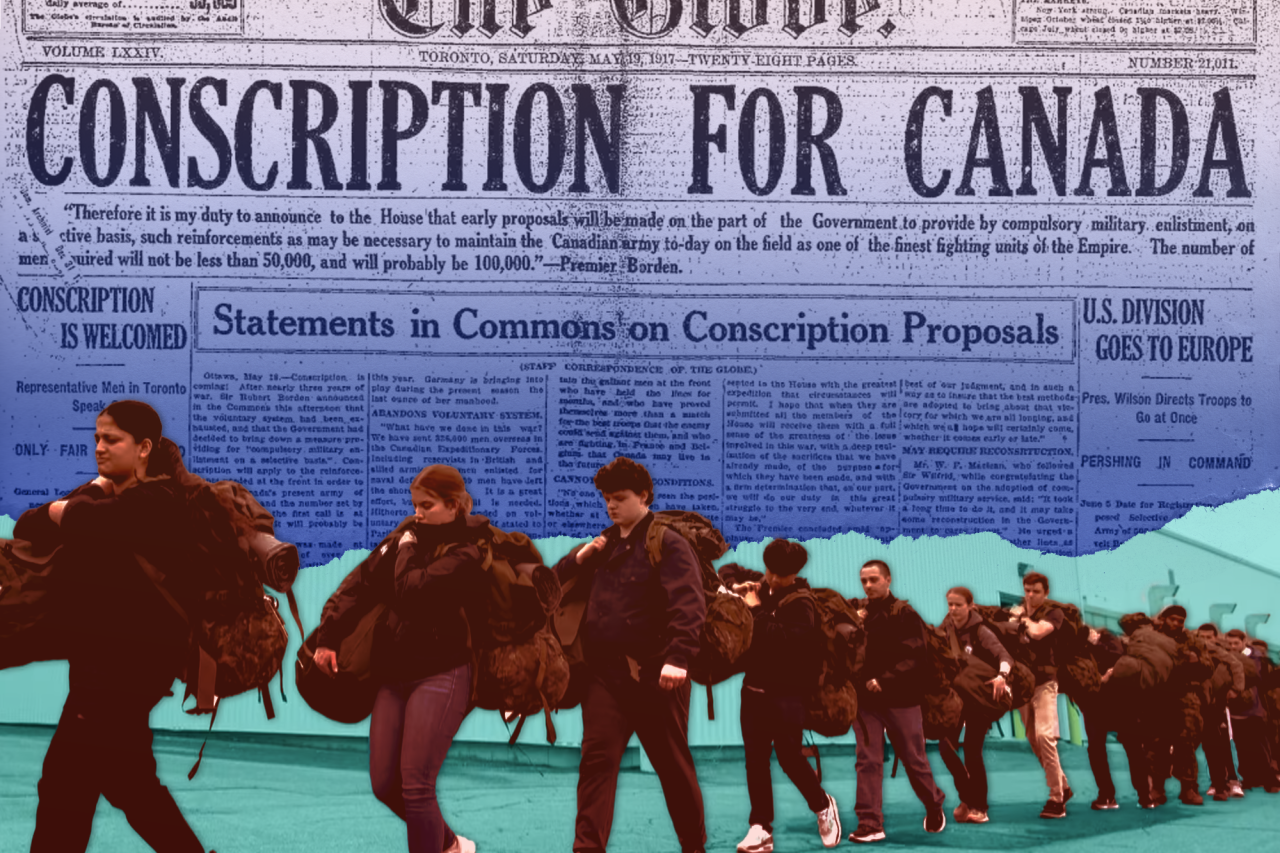
When Canada ended conscription after the Second World War, Canadians breathed a sigh of relief. Now, the elite media want it back.
With Prime Minister Mark Carney embarking on a massive, unprecedented expansion of Canada’s military, the media has been publishing articles calling for a mandatory national service, fawning over conscription in Nordic countries, and uncritically interviewing military leaders who are hand-wringing about falling enlistment.
These articles make the case that a military build-up is necessary to ward off a U.S. invasion. The reality is that Carney has boosted military spending to kowtow to Trump, and major military spending hikes have long been on the wish-list of the corporate elite and defence lobby.
Instead of acting as critics or investigators of this shift, Canadian media is manufacturing consent for it.
Clamour for conscription
During the 2025 federal election, Carney promised his party would increase military spending to two per cent of GDP to meet a requirement set by NATO.
But once the Liberals won a minority government, they pledged to up it to a whopping five per cent by 2035, complying with an even higher target that Trump demanded. That’s $150 billion of public money per year, more than double what Canada devoted at the height of the Cold War.
But militaries need more than money. They need soldiers, and in prior years the Canadian military has faced a “death spiral” of falling enlistment.
So Carney has embarked on a recruitment campaign, boosting entry-level pay and benefits for members of the military. He plans to add 100,000 Canadians to the military’s reserve, and sign up 300,000 more to become “citizen soldiers,” a cohort of volunteers trained in skills such as shooting, driving trucks, and flying drones.
Moving in lockstep with him is Canadian media, publishing articles that lend justification and support to his policies.
In June, the government announced an increase of $9 billion for the Canadian Armed Forces, including higher recruitment targets for the primary reserve. Two days later The Globe and Mail published an article praising Carney’s military funding. Just this week, The National Post celebrated the “rebuilding” of Canada’s military through Carney’s $9-billion funding package.
For now, Carney’s plans to beef up the military rely on volunteers. But elite media is making the case for a mandatory national service that includes joining the military. We’ve seen these calls in Maclean’s, The National Post, and PNI Atlantic News (the Maritimes arm of the mammoth Postmedia news network).
Even progressive independent media have joined the chorus. The Tyee has published articles arguing for boosting military spending, calling for Canada to build a civil defence corps, and even explicitly pleading for conscription.
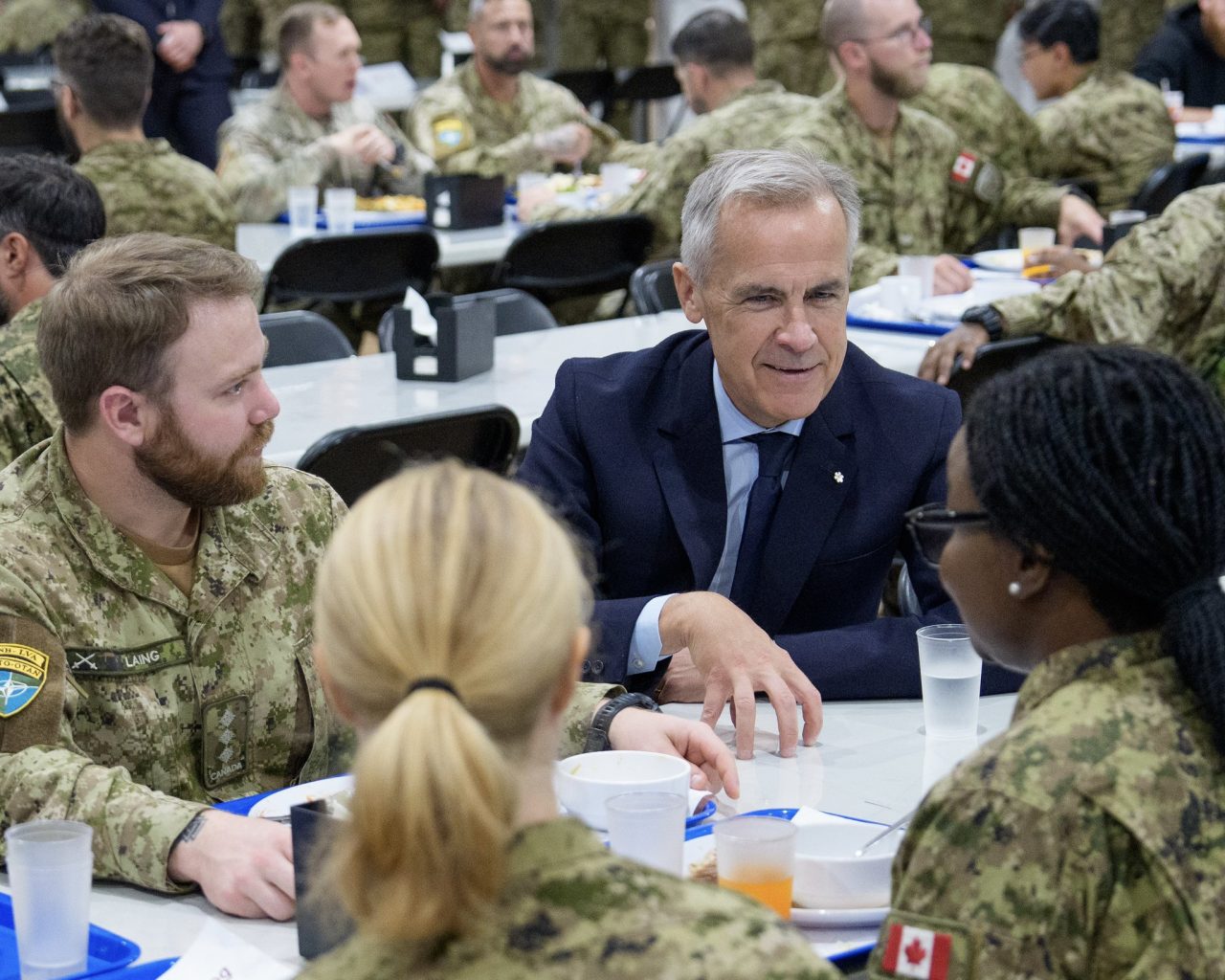
Canadian media’s campaign for greater military spending and recruitment went through an uptick during Russia’s invasion of Ukraine in 2022, when media insisted that Canada could be a target for Russia.
Then in May 2024, Rishi Sunak, British prime minister and leader of the U.K. Conservative party, pitched a wild idea to boost prospects for his party, then struggling in the polls. Sunak said that if he was elected, 18-year-olds in Britain would be required to join the military for a year, or volunteer for “civil resilience”—basically, community service.
Even the former chief of the British naval staff called the idea “bonkers.” But Canadian media lavished it with attention.
One Toronto Star contributor wrote that Sunak “could have inadvertently solved one of Canada’s growing concerns.” Noting the growing number of Canadians accessing food banks, she says “the answer is more volunteers” (rather than, say, governments reining in grocery giants or funding public programs for food security). Military service is only mentioned once in the first paragraph.
The National Post also supported Sunak’s policy, pitched with their own culture-war spin. The author spends most of the article griping that “young people are taught to hate Canada” and arguing that mandatory national service might knock some patriotism into them. She concludes, “We are deluding ourselves if we don’t think that somewhere down the line, we are going to have to fight for our country too.”
These op-eds frontload the necessity of a “national service” where young people volunteer for community organizations, while downplaying the military aspect. But plans to implement a national service are a veiled push for military recruitment and attendant budgets. In PNI Atlantic News, a former Canadian lieutenant-general and a Canadian Forces College professor confirmed that a mandatory national service “would go a long way to address the Forces’ recruitment issue.”
Indeed, the Department of National Defence has begun looking to Nordic countries’ conscription models for advice on their new push to get public servants to volunteer for military service.
In August, a CBC News article profiled Finland and Sweden’s conscription-based militaries, saying Canada might want to “follow in Sweden’s footsteps.” While it’s never said explicitly, the article leads the reader to the conclusion that these NATO allies are clear-eyed about the threat of war, and conscription is the reasonable—even the responsible—solution.
Taking an odd turn, the CBC article revisits the 1939 Winter War, when Finland fought off a Soviet invasion, and says that it’s a reminder of what makes Finland’s mandatory military service “necessary.” The author neglects to mention what came next in history: when the country’s military became active collaborators with Nazi Germany.
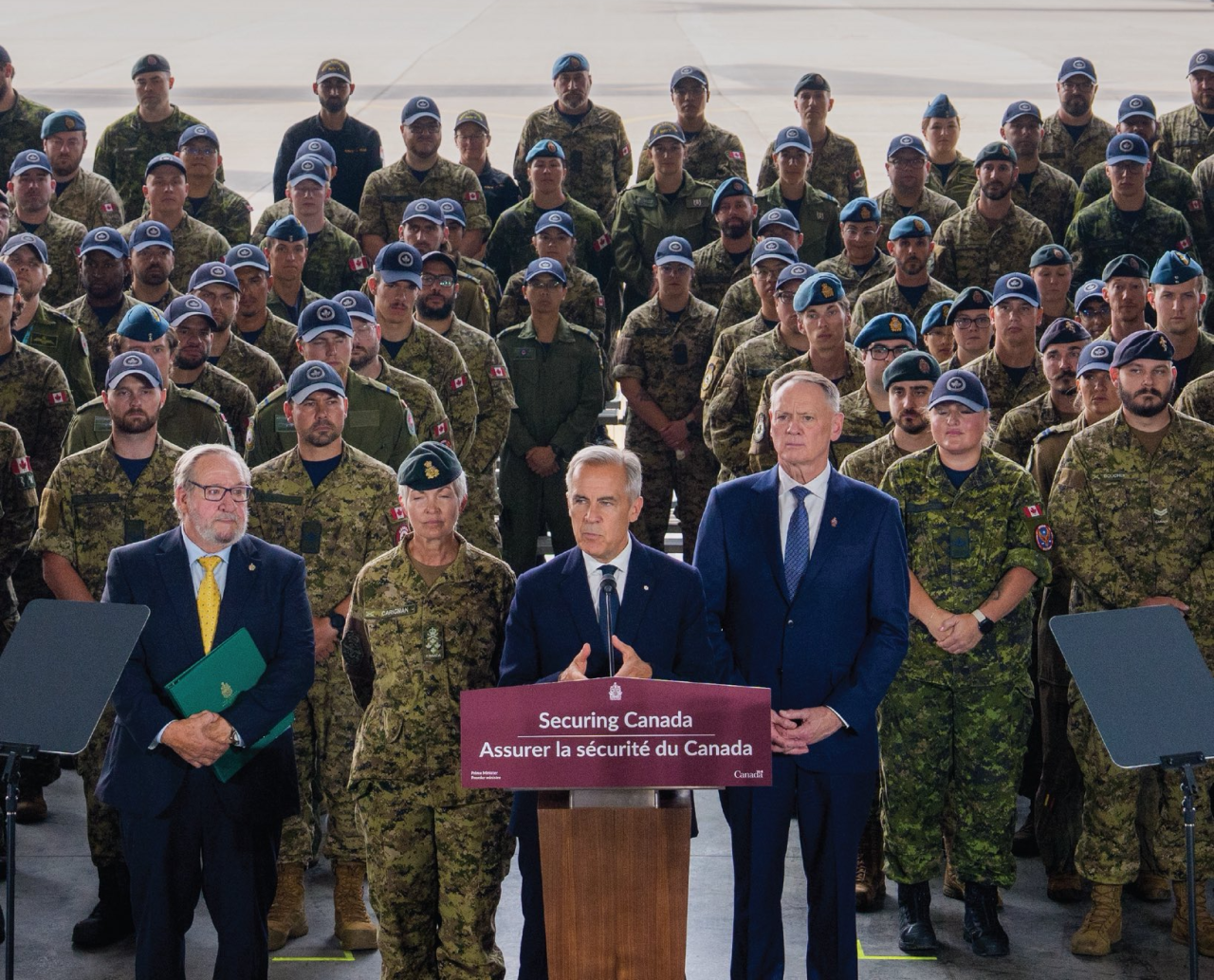
Handouts for war hawks
Recruiting more Canadian civilians into the military is a bad idea, whether they’re volunteers, part-time reservists, or active-duty.
Driving more Canadians to join the military will justify larger military budgets, and larger budgets will mean bigger recruitment pushes, building ever more momentum toward a more highly-militarized society. This militarization is a concession to Trump, not a defence against him.
Putting Canada on ill-conceived war footing leaves little room for spending on things that would actually improve Canadians’ lives: investments in clean energy, public health care, and transit. Let’s not forget that while expanding military positions and pay, Carney is cutting 40,000 jobs from the public service.
Behind the “elbows up” rhetoric, Carney’s increase in military spending will tie Canada closer to the U.S. One Canadian Army program will spend up to $500 million on U.S. equipment. Another major defence contract from last July included technical requirements that reduced candidates to just one U.S. company.
Militaries are massive contributors to climate change. The top brass of the Canadian Armed Forces have acknowledged that the military is peppered with white supremacists and plagued with sexual misconduct. Reports of hateful conduct in the military have spiked in the past year.
Our entire news ecosystem rests on the view that more arms and soldiers are a fundamental good. With the war in Ukraine and Trump’s threats providing ample rationale, the Canadian news giants are giddy to celebrate Carney’s massive military spending.

“We need media that enlarges the sense of what’s possible.”
Naomi Klein, journalist and author
Want to support hope-fuelled journalism? Become a sustaining member.
Federal Government | A budget for tanks, banks, and oil barons

Weapons Industry | Trump’s Golden Dome turbocharges the war machine—and Carney wants us to pay for it
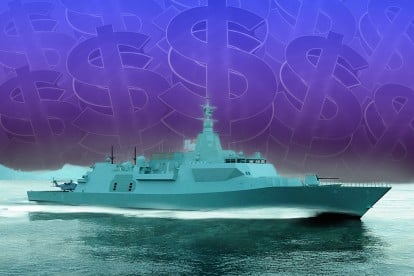
Foreign Policy | The Irving empire just landed an $8B payday—for warships no one asked for
9 comments
Comments are closed.

très bien. Very good merci.
I am completely against what the author of this article wrote. Having a civil defence force isn’t only about fighting militarily; it’s also about citizens knowing what to do and where to go during regional and national emergencies. As for our armed forces they have been neglected for far too long.
On civil defence preparedness, the comment makes an excellent point. Canada’s emergency preparedness infrastructure is remarkably underdeveloped compared to countries facing similar risks. We saw this during COVID-19, the BC floods, and Quebec ice storms – coordination was often improvised rather than systematic. Countries like Switzerland have robust civil defence systems where citizens know their roles during emergencies, have designated shelters, and practice coordinated responses. This isn’t militarization; it’s basic civic infrastructure that saves lives during floods, fires, power grid failures, or yes, military threats.
On military neglect: The framing assumes military spending serves “social interest” – collective security and emergency response. But we should examine whose security interests are actually being served by Canada’s current military expansion trajectory.
Carney’s pivot to increased defense spending – prioritizing NATO commitments and continental defense integration with the US – represents “possessive individualism” masquerading as collective good. The question isn’t whether our forces have been underfunded, but what they’re being funded to do. Are we building capacity for genuine Canadian sovereignty (search and rescue, Arctic monitoring, disaster response, coastal protection)? Or are we deepening integration into US-led military operations that serve American geopolitical interests while making Canada less secure by tying us to Washington’s conflicts?
You comment deserves engagement on civil preparedness while questioning the military spending narrative’s underlying assumptions about who benefits.
What are our children being taught to do? It’s a razors edge. Do you believe in the platitudes (which are indeed quite good) or do you believe that their is too much falsehood and propaganda? I wish for good, but are we going to get it?
I agree completely.
I agree with you.
I am disappointed with the Breach so much that after years of reading good content, I am unsubscribing.
Canada needs to grow up to defend itself from the US and to meet its international responsibility. I have volunteered for 40 years to protect the environment against climate change and political overreach.
But our most immediate risk has become sovereignty.
We cannot do the work needed on climate change if the US overcomes our economic independence and forces Canada into climate action concessions. The US has shut down all federally funded climate initiatives.
Please The Breach. Do better.
Interesting. I would agree with much of this. And I am certainly glad to know about projected defence spending on American-made weapons. Not a good idea. At all. However — although I have always considered myself a peacenik— I remain convinced that Canada needs increased armed forces. We need (a) a civil defence force, capable of dealing with many kinds of emergencies. And we also need (b) a well-trained, well-equipped military. Of course we need to form alliances with Europe, Australia, New Zealand. We need to be equipped to defend the Arctic. The writer here does not indicate how we are to repel a potential American invasion. How we are to assist Ukraine. How we are to deal with a vastly changed geopolitical landscape. We need to rearm very very wisely, of course. But to ignore the way we are being eyed as a fat, rich, quiescent resource, teeming with water and critical minerals — especially by the USA — is to shut our eyes to the risk of a catastrophic loss of sovereignty. I don’t want that. I’d like to know how the author of this piece would address that — to me — unacceptable risk.
Until the rise of the far-right and the threats from Trump and his administration, I was not for increasing defence spending. However, times have changed and we need to be prepared along with other Arctic nations and the EU. We face an unstable leader and administration to the South and we can no longer be vulnerable to invasion. If I, as a Senior Citizen, can contribute some skills from my professional life, as a volunteer, sign me up! This article seems rather naive.
Conscription ? My dad and grandfathers were veterans. As dad said, let the elite and politician’s kids serve first.